







































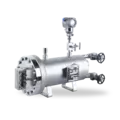


Click image to enlarge
LSC6000A4
A From mechanical seal
B To vapor collection system
C Drain
LSC6
Leakage collection reservoir
Features
The EagleBurgmann leakage control systems of the LSC6000A4 range are utilized to collect condensing or mixed phase leakage - vapor passing through. A level indicator is installed to determine when the tank needs to be drained. A pressure gauge tracks and indicates seal leakage.
Advantages
- Leakage collection tank with sight-glass
- Modular system: combination with a wide range of monitoring instruments possible
Standards and approvals
- API 682 / ISO 21049
- API 682 4th ed. Cat. 2/3 - 2CW-CS
Recommended applications
- Refining technology
- Oil and gas industry
- Petrochemical industry
- Chemical industry
- Power plant technology
Functional description
The LSC6000-A4 leakage control system is used to discharge leakage from liquid-lubricated single seals with downstream safety gas seals where the leakage is liquid under atmospheric conditions.
Notes
Design and production in accordance with EU Pressure Equipment Directive PED 2014/68/EU available.
Design, calculation and production acc. to ASME VIII, Div. 1 available.
3rd party inspection, ASME stamp on request.
Recommended piping plans
Product variants
| Designation | LSC6000A4 |
|---|---|
| Pressure Equipment Directive | PED 2014/68/EU | ASME VIII, Div.1 |
| Volume of vessel | 14 l |
| Allowable pressure1) | 44 bar (638 PSI) |
| Allowable temperature1) | -20 °C … +120 °C(-4 °F … +248 °F) |
| Connection seal leakage | Flange 3/4", 600 lbs |
| Connection collecting system for condensing leakages | 3/4" NPT(f) |
| Connection fluids collection system | Flange 3/4", 600 lbs |
| Metal parts | 316/316L |
| Gaskets | PTFE, Burasil, Viton®, FKM |
Other versions on request.
1) Design data, permissible working values depend on the actual conditions of service.
