







































Optimally designing mechanical seals
Several factors play a role in the selection of a mechanical seal, the mechanical seal type, the materials used, and the manner in which a mechanical seal will be operated: process conditions, sealing point where the mechanical seal will be used, operating conditions, and the medium to be sealed. Every system will only work as well as its individual components. If one mechanical seal functions smoothly, then it will lead a largely uneventful life. But as soon as the leakage rate rises or if the mechanical seal even fails, its importance quickly becomes self-evident. Mechanical seals are therefore very important in terms of process stability, plant safety, and economic viability.
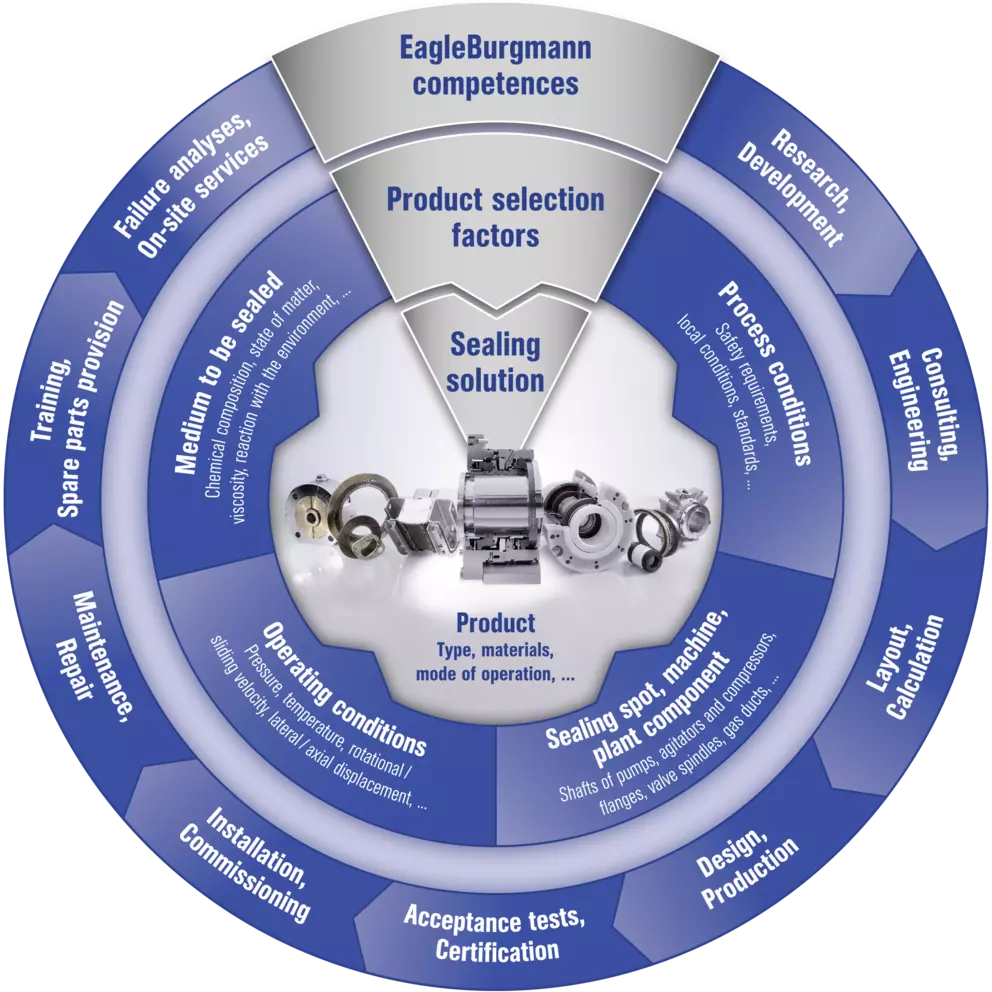
IMPORTANT FACTORS AND COMPETENCIES FOR THE SELECTION OF MECHANICAL SEALS
Elements of a mechanical seal
The mechanical seal essentially consists of two flat, annular sliding surfaces that are pressed together. One sliding surface is fixed to the stationary machine casing, while the other sliding surface is fixed to the rotating shaft. The medium to be sealed, which is generally in contact with the outer edge of the sliding surfaces, penetrates the gap between the sliding surfaces, forming a lubricating film, and emerges at the inner edge as leakage. The pressure differential to be sealed is established in the radial direction. In its simplest form, a mechanical seal can be imagined as a collar that is arranged on, and rotates with, the shaft.
Definition of mechanical seal (abbreviated GLRD)
A mechanical seal is a machine element made to seal the passage point of a rotating part (usually a shaft) through a wall (usually the machine casing). Features of the mechanical seal are two surfaces sliding on each other – usually arranged at right angles to the rotational axle – which are pressed together by axial forces. Between the sliding surfaces is a liquid or gaseous lubricating film.
Every mechanical seal possesses five basic elements:
1. One ring (usually the seal face) circulating synchronously with the rotating part (shaft)
2. Secondary seal (usually O-ring) between shaft and ring
3. A stationary ring (usually the stationary seat) arranged in the stationary part (casing)
4. Secondary seal (usually O-ring) between these parts
5. Spring for the seal face
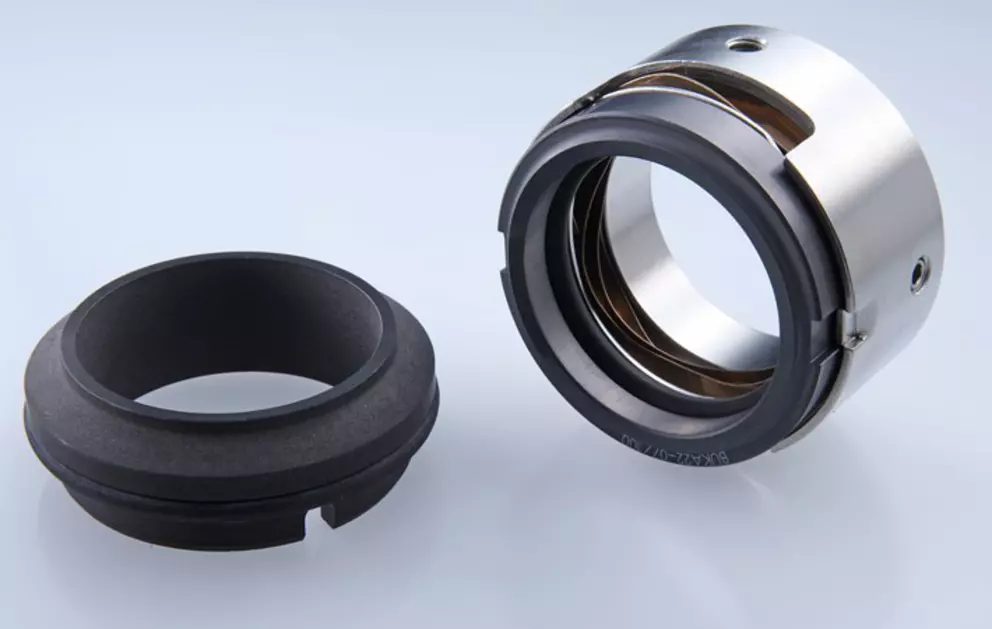
Independent of the direction of rotation mechanical seal EagleBurgmann M7N for pressures up to 25 bar, temperatures from -50°C to +220°C and sliding velocities of up to 20 m/S (vg).
Mechanical seal EagleBurgmann M7N , as frequently used in applications of the process industry , in the sector of water applications , or as used in the food industry .
1. Seal face
2. Secondary seal
3. Stationary seat
4. O-ring
5. Spring