





































Using the "Best Available Technique" is always a good idea
An interview with Daniel Goebel, Sales Director Compressor Sealing Aftermarket (EMEA region)

European environmental legislation requires the use of “Best Available Techniques” (BAT). “Reducing this requirement to the content of a regulation does not do justice to the potential of this approach,” says Daniel Goebel, Sales Director Compressor Sealing Aftermarket at EagleBurgmann (EMEA region), and he further explains how the “Best Available Techniques” can be optimally applied in many ways with the support of EagleBurgmann.
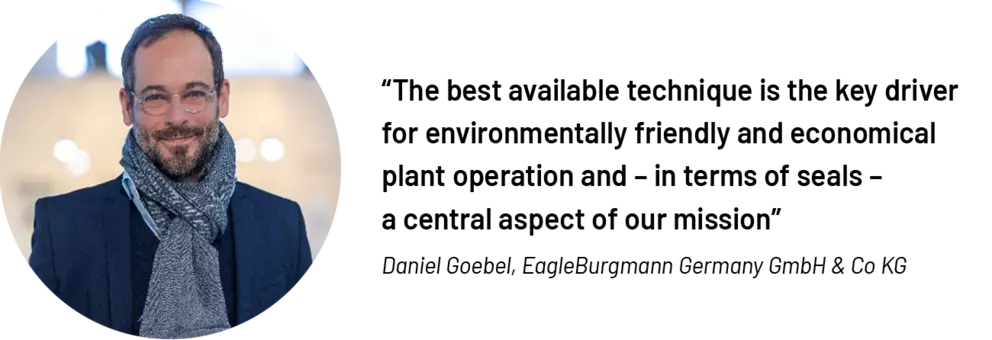
So the use of the “Best Available Techniques” is more than just an inconvenient requirement to be met?
Goebel: Absolutely! The legislation persues certain goals, such as reducing emissions, improving energy efficiency and minimizing waste. In other words, it serves to improve living conditions and promote sustainable development. Ideally, technological innovation will follow and make improvements possible.
In this way, the concept of “Best Available Techniques” is not just about complying with laws and regulations. It also makes the operation of systems more efficient or economical – provided that the right technology is used in the right place.
Lawmakers have kept the requirements general to maintain vendor neutrality – won’t that cause problems in practice?
Goebel: Yes, but I believe that many practical problems are the result of misconceptions. The “Best Available Techniques” is a concept that is applied to many technical fields, in our case to sealing technology. Operators need to take a holistic approach to this concept or work with partners who will support them. This is particularly important for special applications or in fields where rapid innovation is a major factor. Both aspects apply to sealing technology, and it is not easy to have or maintain a good overview of the “Best Available Techniques” in each case.
Is there any information on the “Best Available Techniques”?
Goebel: There is. Examples include the BAT reference documents and BAT conclusions as well as industry-specific documentation on the current state of the art. These are provided by the European IPPC office in Seville. However, the specifications for “mechanical seals” are only very general. Expedient refinement and consolidation is currently a task of the Seville process.
Internationally, the requirements of the American Petroleum Institute (API) and many other regulations and recommendations also provide guidance.
As an operator and plant manufacturer, where do I get information about the innovations of the seal manufacturers?
Goebel: This important information on innovations, which may deliver a better overall result than “just” complying with regulations, is presented in specialist media, at trade shows and presentations or in manufacturer’s documentation, to name just a few examples. However, these are only starting points. The best solution for the specific application is then developed in dialogue with people like our experts. We are currently engaged in intensive discussions with operators on this matter. One of the topics is how to reduce methane emissions from gas pipelines. Our CobaDGS zero-emission seal is a good example of innovation in this area. There aren’t any regulations requiring it yet, but it not only reduces emissions but also increases system reliability. It forms the basis for some interesting business cases.
Work on the introduction of BAT is under way in many areas, but the specifications are lagging behind technical developments ...
Goebel: ... unfortunately this is the case and will only change if technological development is slower than the qualification processes. But this is not the situation we should wish for, because environmentally friendly and sustainable industrial production requires forward-looking innovations. It’s good that we have so many innovations and are able to make progress in current trends. Our innovations, such as new groove designs for seal faces, low-friction seals or the aforementioned CobaDGS seal, open up interesting potential for plant manufacturers and operators today. The goal of our developments is always to minimize leakage, increase efficiency and extend the plant’s service life.
Back to the term “Best Available Techniques”. Does this just mean the best technical solution?
Goebel: No, it’s about the best technical solution for an application within the scope of its relevant application criteria. For example, the design of the seal itself can make all the difference in terms of reduced leakage and/or more efficient plant operation. Other starting points include optimization of the supply system or monitoring logic. This makes it all the more important to be clear about what your operational objectives are. This will lead to the best overall solution, taking into account the commercial aspect, of course. As such, the Best Available Techniques do not lead to the same sealing solution for every application.
You mentioned the economic aspect. Does the use of “Best Available Techniques” come with higher costs?
Goebel: This is a question of perspective and varies from operator to operator. When an operator focuses on meeting new requirements on short notice, costs automatically take center stage. However, if he focuses on the service life of the production facilities, which I think is sensible, a different picture emerges. Longer service life and maintenance intervals, lower consumption and fewer leaks, etc. quickly reveal interesting efficiency potential as part of a solid total cost of ownership analysis. At the start, it’s irrelevant whether the “Best Available Techniques” are used.
What do you mean?
Goebel: I can consider BAT for new installations or revisions to meet regulatory requirements. This is standard practice. However, an upgrade to the Best Available Techniques can also be worthwhile, especially in the case of technical innovations that meet key market requirements. Today, this also includes sustainable and environmentally friendly plant operation. It must be made clear that systems based on the Best Available Techniques have lower energy consumption, longer service lives and enable safe operation for people and the environment.
How great is the current demand for sustainable and environmentally compatible solutions?
Goebel: On the one hand, it is growing and exceeding requirements such as those set by the German Technical Instructions on Air Quality Control (TA Luft) . More and more plant operators are aware of their responsibility, and we are happy to support them because the best available sealing technology offers great leverage to achieve the set goals.
On the other hand, we see all too often that the initial costs for an upgrade, for example, are the primary consideration, rather than the total cost of ownership. This is a shame because an appropriate upgrade can provide a quick return on investment, which can be anywhere from one to three years, depending on the system and its impact. This is why a holistic approach is so important.
But “holistic approach” is an imprecise term. What do you mean by that?
Goebel: In addition to the aspects mentioned above, system manufacturers and operators must consider the ever-increasing pace of technological development and the entire lifecycle of a system or product. The resulting product life cycle management also requires system manufacturers to take a close look at the operating conditions and production goals of the operators and work together to develop solutions. For example, the focus may be on how a product can be manufactured and repaired with the smallest possible environmental footprint.
Other topics include energy and resource consumption. In addition to the classic requirements such as minimizing leakage or increasing energy efficiency, we are currently working on concepts to extend the service life or the “mean time between maintenance (MTBM)”. We offer solutions such as our Smart Seal concept for this purpose. Through extensive data collection and analysis, we help to better understand systems and components in operation, thereby extending their service life and improving operational efficiency.
How does EagleBurgmann provide concrete support when it comes to implementing TA Luft, for example?
Goebel: It all starts with application engineering consulting to determine the best technical, economic and regulatory solution. This is where our broad product range and application expertise come into play, allowing us to serve virtually any application in a wide range of industries. Our products range from multiple mechanical seals and the associated seal supply systems to magnetic couplings, multi-chamber lip seals, flange seals, shut-off and control seals, carbon floating ring seals, expansion joints and speciality seals.
We also assist operators in obtaining official approvals for plant operation when they use new technologies. We then support you with comprehensive services to ensure efficient and safe operation. These range from optimized inventory management, assembly, maintenance and repair to technical analysis, consulting and engineering, such as reliability engineering or “bad actor support”. When upgrading the sealing technology, a dedicated team ensures that the best solution is safely integrated into the systems. Finally, we train the technical staff at our facility or at the customer’s site. This holistic approach makes the total cost of ownership a realistic and tangible figure.
Many regulations, such as TA Luft, only apply in Germany. How does your support adapt to globally operating companies?
Goebel: Quite flexibly, but the same way in principle. EagleBurgmann itself is a global company with an international presence. Operators can contact their nearest customer center to work with us on a case-by-case basis to implement suitable solutions that meet the requirements of the country in question.
However, compliance with regulations such as TA Luft is only one aspect. There are several sets of international regulations, some of which have been adopted, are under development, or are in the planning stages. What they all have in common is the goal of protecting the environment and people. These goals are the same in Europe, the Americas, and Asia. Local regulations such as TA Luft are then implemented in Germany but also have an impact on other countries. Regulations are just one aspect, albeit an important one. Our aim is to make advancements with the “right” innovations in order to serve sustainable development. With this approach, we see ourselves as the “technical” market leader. We can offer good solutions that both comply with regulations and provide added value to operators and equipment manufacturers.
Would you like personal advice, do you have any questions or would you like to order directly? We look forward to supporting you.


