







































Clean sealing solution for demanding crystal production
Double seal AGSR for a vacuum paddle dryer

Situation
Seal usually lies in the product, crystals agglomerate
Challenge
Eliminate contamination of crystals caused by barrier medium and abrasion of the sealing surfaces
Solution
Double seal AGSR from EagleBurgmann
Liquid crystals are complex organic compounds that are used, for example, in LCD flat screens (LCD = liquid crystal display). Electric voltage influences the orientation of the liquid crystals and the resulting light transmittance makes it possible to display the image. Even the smallest impurities in the production of liquid crystals affect their conductivity.
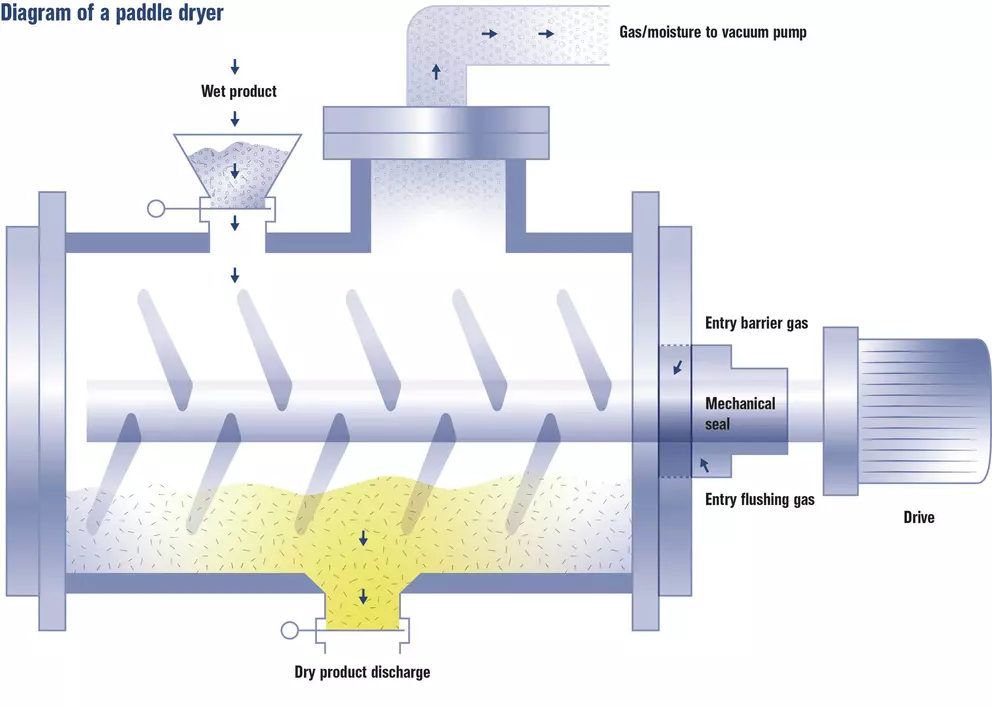
For many years, the Performance Materials business unit of Merck KGaA in Darmstadt/Germany has been using gas-lubricated mechanical seals of the AGSR series from EagleBurgmann that meet the demanding requirements for purity and cleanability in the production of liquid crystals. The seals are installed on the shafts of the side drives of several horizontal paddle dryers in which the crystals are dried.
The crystals are usually produced in a batch process and are present in various solvents such as toluene or methanol. Because of their physical properties, the crystals can easily accumulate on the seal. It is therefore essential to continuously flush the seals during operation. They must also be suitable for CIP processes (CIP = Cleaning In Place) in order to prevent subsequent batches from being contaminated by previous production and to ensure the function of the seal.
In horizontal paddle dryers such as those used at Merck, the seals are also usually to be found in the product. It is therefore necessary to reliably prevent contamination from the barrier medium used as well as abrasion from the sliding faces. A further requirement for the sealing system was compliance with Directive 94/9/EC (ATEX 95) or 2014/34/EU, which regulates the commissioning of machines in potentially explosive atmospheres.
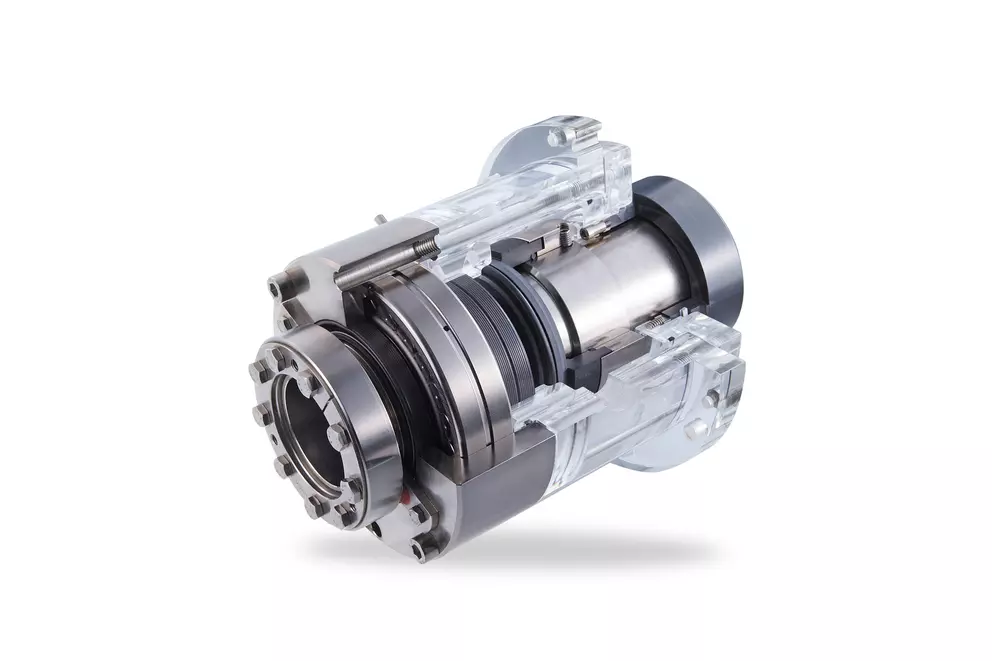
The AGSR mechanical seal from EagleBurgmann is a gas-lubricated double seal. Since the seal faces run without contact, contamination through abrasion from the sliding faces is avoided from the outset. Specific design features of the seal, such as smooth surfaces in contact with the product and an open O-ring groove design, contribute to optimized cleanability. As a result, the seal is also suitable for sterile applications. A flushing system integrated in front of the dynamic sealing element on the product side is permanently supplied with nitrogen during operation. It also simplifies cleaning using the CIP process. This increases the operational reliability of the seal because it reliably removes product residues.
Dry nitrogen is used as barrier and flushing medium. As an inert gas, it is slow-reacting and therefore suitable for use in potentially explosive atmospheres. Large sealing surfaces in conjunction with an appropriate groove design ensure a high rigidity of the gas film and thus a reliable sealing function and low nitrogen consumption.
In addition to regular CIP cleaning via the flushing gas connection, the continuous application of buffer and flushing gas contributes to the extension of service life. This protects the seals even during standstill. As a further measure to increase the service life, regular buffer gas pressure surges were established during drying. Despite the demanding operating conditions, the gas-lubricated mechanical seals AGSR at Merck achieve a long service life of several years in practice.
- Temperature: t = 20 … 100 °C (68 … 212 °F)
- Tank pressure: p1 max. = 0.001 … 1.1 bar (0.015 … 15.9 PSI)
- Buffer pressure: p3 max. = 5 … 7 bar (72.5 … 101.5 PSI)
- Barrier medium: dry nitrogen
- Speed: n max. = 2 … 20 min-1
- Media: organic, crystalline substances in various solvents (toluene, methanol, etc.)
- ATEX: Ex zone 1 and 21


