







































Flexible and hygienic expansion joints for dairy products
Patented PLUG & RUN expansion joints

Situation
Expansion joints have to be moved to different connections in a large number of silos.
Challenge
Reduction of changeover time. Moving the compensators leads to time-intensive screwing and unscrewing, which is reflected in increased set-up times and reduced system availability.
Solution
PLUG & RUN compensators from EagleBurgmann, with a new patented quick lock system
Expansion joints are flexible connectors which compensate for vibrations between rigid and movable components in industrial production plants. To prevent contamination of the product, e.g. foods, it is absolutely essential that these expansion joints, beginning with their manufacturing, adhere to the strict guidelines with regard to their structural shape and materials. While in use at a dairy plant, the installed expansion joints showed high signs of wear. Furthermore, the operating conditions required a time consuming daily change of the expansion joints. By means of custom-made PLUG & RUN expansion joints with a more wear-resistant material, EagleBurgmann was able to provide a solution which ideally fulfills the requirements with regard to wear while at the same time significantly reducing the changeover time.
In one of Europe’s most modern dairy plants in Eastern Germany, round about 2 million tons of milk are processed every year.
The manufacturing plant also comprises 12 vibration feeders, each of which is connected to one silo and two pipelines. Expansion joints at the connection points ensure that vibrations are not transferred to the rigid pipe system and the silos.
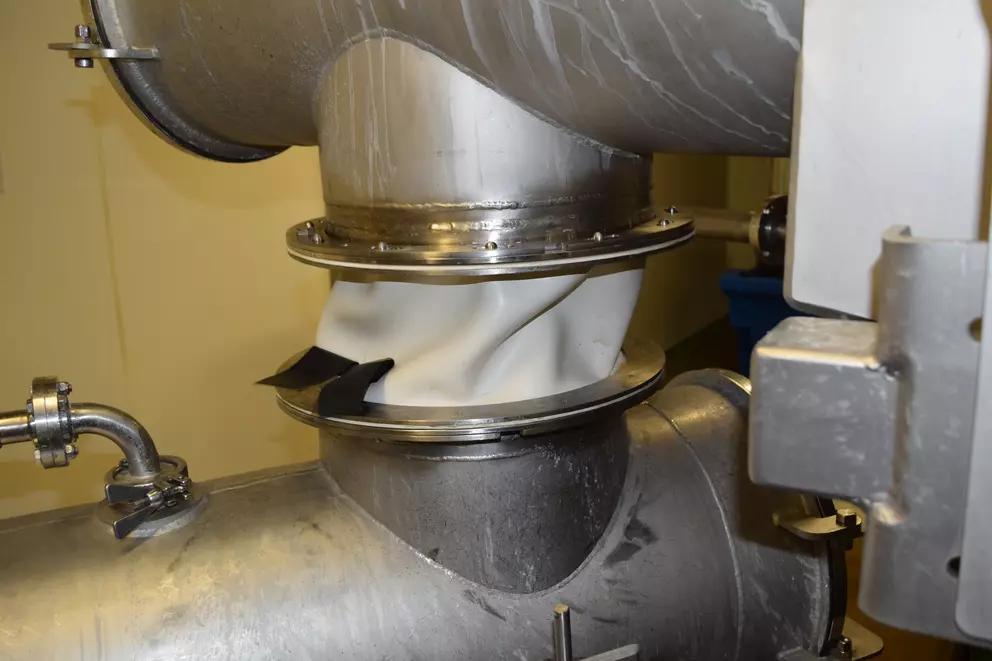
Due to the multitude of silos, the expansion joints need to be switched from one connection to another on a daily basis during the filling of the silos. Up until recently, this process involved a time consuming dismantling and installation. High changeover times resulted in reduced plant availability.
Furthermore, the abrasive nature of the lactose together with the mechanical stress caused by the vibration feeder led to a quick wear of the expansion joints. While the pressure requirements for the application are low, the expansion joints must be able to withstand the high temperatures of the cleaning process. When cleaning with acid, temperatures of up to 65 °C can occur. The use of water as cleaning agent can result in the temperature rising as high as 80 °C. The lifetime of the expansion joints amounted to only a couple of months after which a replacement was necessary.
The new PLUG & RUN expansion joints developed by EagleBurgmann were designed to rectify these shortcomings while simultaneously adhering to the strict hygienic and safety requirements in the food industry. To suppress microbial growth and facilitate the daily cleaning by means of CIP/SIP, gaps and cavities in which the product or cleaning agent can accumulate must be prevented. In addition, the used expansion joint materials must be resistant against the corresponding cleaning agents, in this case a 1.5% solution of nitric acid.
The solution, specifically designed for the customer, is equipped with a new and patented quick lock system. The change of the expansion joints is now reduced to a few simple steps and takes less than a minute.
The fabric of the new expansion joint is white nitrile. The soft material of the PLUG & RUN system is heat-proof and abrasion-proof. Due to its high elasticity and wear resistance, the nitrile achieves a long lifetime despite the vibrations. All materials which come into contact with food (Food Contact Material = FCM) were tested according to relevant guidelines such as DIN EN 1935-2004. These guidelines for example stipulate that FCMs may only release substances or absorb product in very small quantities.
Apart from the material properties, the cleanability was also improved compared to the previous expansion joint. Regarding the realm of “Hygienic Design”, the size of the area between the flange system and expansion joint in which product can collect was held to a minimum. The obtuse angle at the flanges and the added nose design for safe clamping and reduced formation of crevices reliably prevent accumulation of the product. Furthermore, the PLUG & RUN System withstands all cleaning agents in use.
“Despite the fact that these were prototypes, the PLUG & RUN expansion joints proved their worth straightaway”, says Jonny Hilgenfeld, Area Sales Manager at EagleBurgmann. “ The change among the silos takes place in a matter of minutes and reduces the downtime associated with this process. While the previous expansion joints were worn-out within months, our PLUG & RUN system has been in use for over a year now.” Due to the fact that the introduction of this design as standard for the plant promises even more optimization potential for the customer, the continued conversion to PLUG & RUN is already being planned.
- Temperature: acid max. 65 °C, hot water 80 °C
- Process medium: lactose
- Expansion joint diameter: 350 mm


