








































Click image to enlarge
| Item | Description |
|---|---|
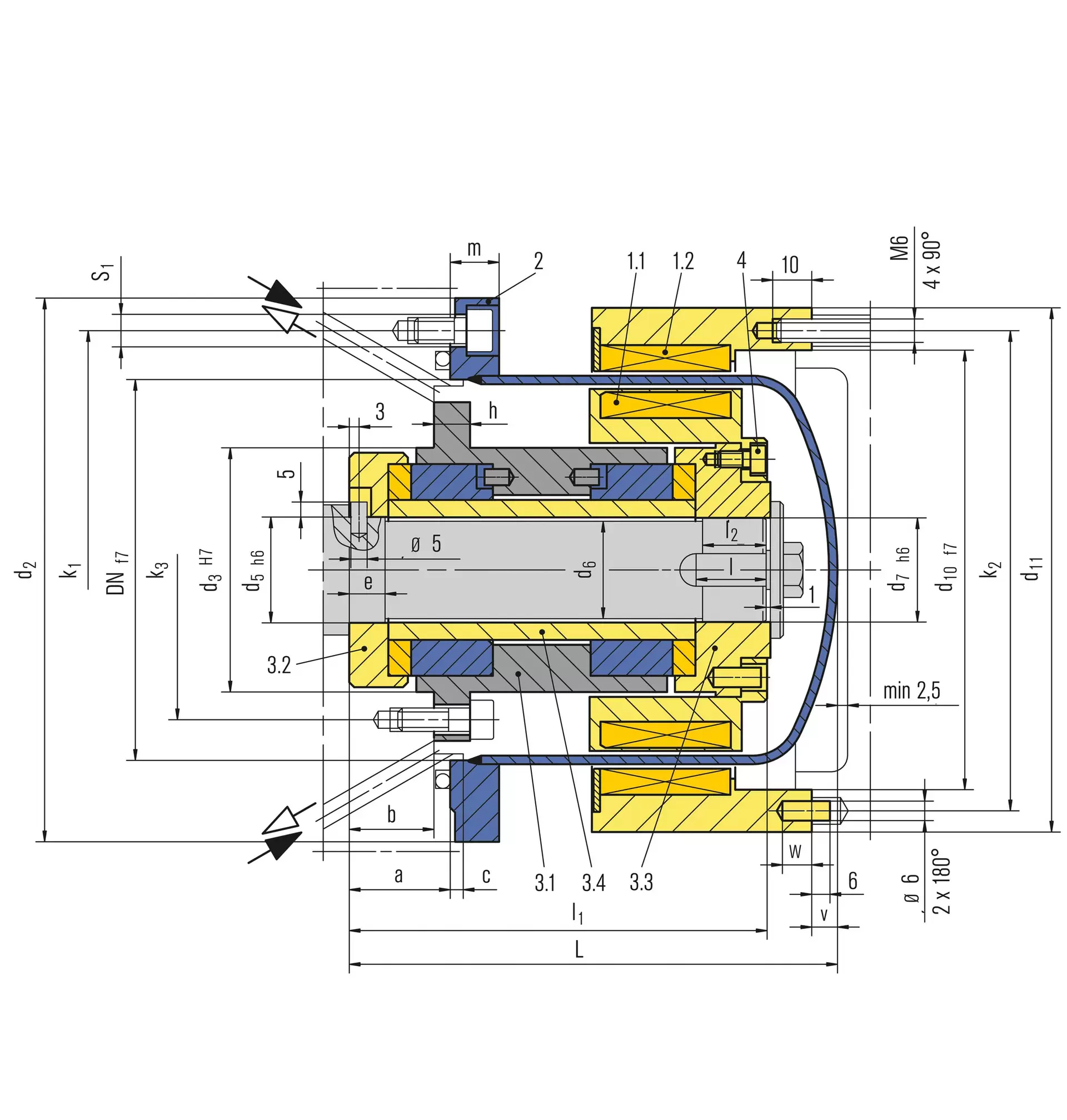
| 1 | Coupling |
| 1.1 | Inner rotor |
| 1.2 | Outer rotor |
| 2 | Can |
| 3 | Bearing assembly |
| 3.1 | Radial journal bearing |
| 3.2 | Axial journal bearing |
| 3.3 | Axial journal bearing |
| 3.4 | Shaft sleeve |
| 4 | HSH cap screw |
MAK66
Features
Magnetic couplings (MAK) are a hermetic sealing solution for pumps and agitators. Dangerous or precious media remains isolated in the closed system circuit.
Advantages
- Magnetic coupling for standard applications
- Hermetically sealed
- No contact of torque transmitting elements
- No maintenance necessary
- Hastelloy® or Inconel® can for high performance
- High efficient can optional
- Product lubricated sliding bearing included
Operating range
Shaft diameter: d = ... 40 mm (1,57")
Pressure: p = 25 bar (363 PSI)
Temperature: t = -40 °C ... +250 °C (-40 °F ... +482 °F) (SmCo),
+120 °C (+248 °F) (NdFeB)
Speed: n = 3,600 min-1
Chemical resistance: pH 0 … 14
Viscosity: 0.3 … 5,000 mPas (SiC)
Torque: max. 462 Nm
Solids: max. 0.1 mm; max. 5 % by weight; grain hardness max. 700 HV
Materials
Sliding faces: Silicon carbide SiC (Q1),
Carbon silicon impregnated SiC-C-Si (Q3),
Carbon graphite resin impregnated (B)
Magnets: Samarium Cobalt (MA3),
Neodymium-Iron-Boron (MA8)
Metal parts: CrNiMO steel 1.4571 (G), CrNiMo steel 1.4462 (G1), Hastelloy® C-4 2.4610 (M), Inconel® 625 2.4856 (T3)
Standards and approvals
- Compliant to TA Luft (German Clean Air Act)
Recommended applications
- Chemical industry
- Oil and gas industry
- Refining technology
- Pharmaceutical industry
- Food processing industry
- CCUS
- Power generation
- Centrifugal pumps
- Gear pumps
- Top drive mixers/agitators
- Fans
- Blowers
- Autoclaves
Functional description
The power transmission occurs contact-free through magnets from the drive shaft to the product wetted output shaft. Between the two rotating parts is the can wich is bolted to the container.
Notes
Different variants are available to meet specific requirements:
- Coolable or heatable bearing arrangements
- Vertical drive with dry running roller bearing
- High temperature variant
- Without bearing
Can variants:
- Double wall
- High pressure can
- Ceramic, PEEK carbon fiber, Titanium cans
Product variants
Static break-away torque (Nm)
| DN | **** | 60 | 75 | 110 | 135 | 165 |
|---|---|---|---|---|---|---|
| No. of poles | 8 | 10 | 16 | 20 | 24 | |
| Material | MA3 | MA8 | MA3 | MA8 | MA3 | |
| Magnet length in cm | 2 | 8.4 | 10.5 | 11.5 | 15.5 | 27 |
| 4 | 18 | 21.9 | 25 | 33.5 | 59 | 78 |
| 6 | 27 | 33.8 | 37.5 | 51 | 90 | 126 |
| 8 | ||||||
| 10 |
Static break-away torque [Nm] at room temperature. Magnet material: MA3 = SmCo, MA8 = NdFeB
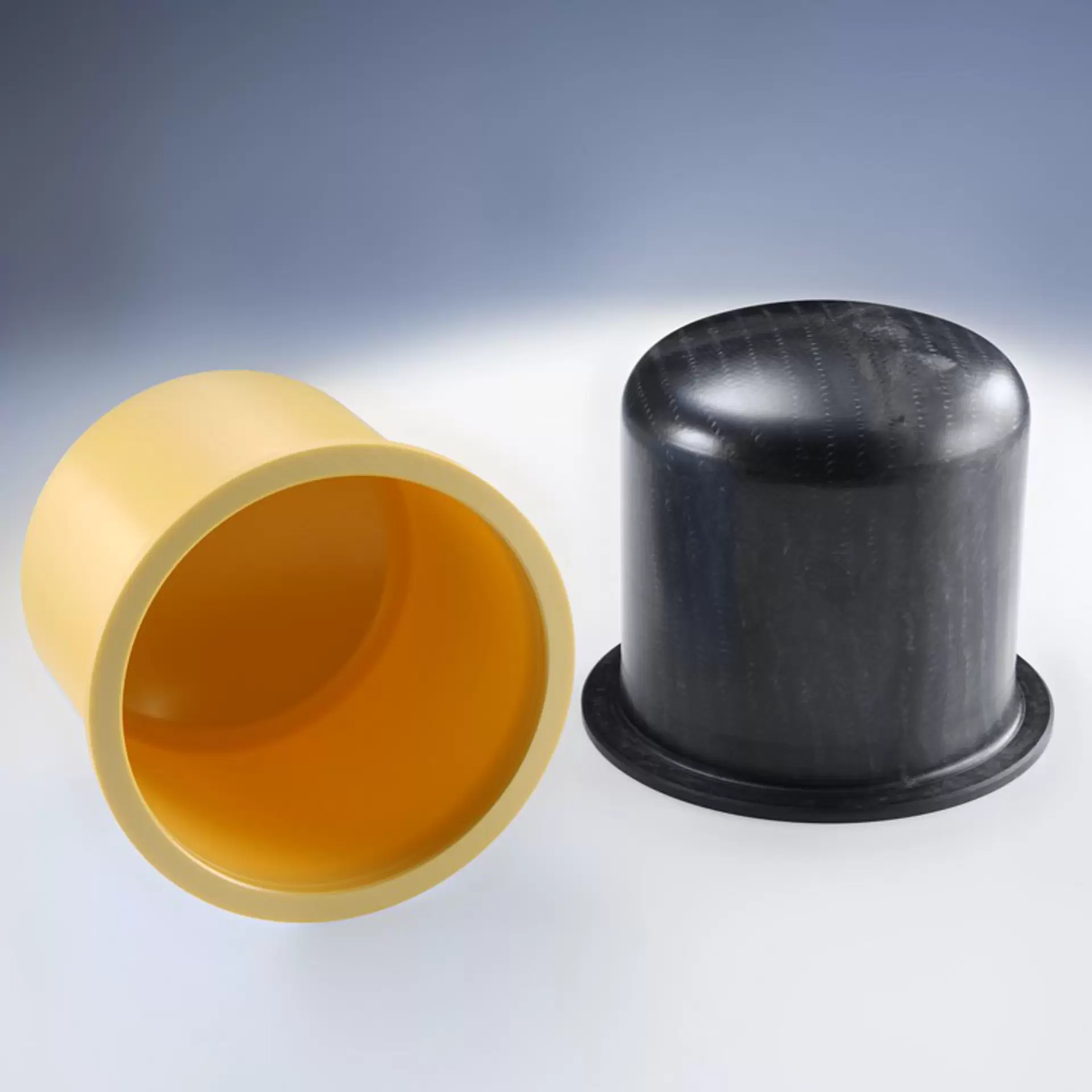
Ceramic and PEEK carbon fiber can variants
Containment shell (can) versions in ceramic or carbon fiber reinforced PEEK
material provide efficiency gains in magnetic couplings
by reducing eddy current losses to zero.
Operating limits
Ceramic can: pressure up to 25 bar (363 PSI), temperature up to 350°C (662 °F)
PEEK can: pressure up to 40 bar (580 PSI), temperature up to 150°C (302 °F)
Other limits are available on request


